The company also introduced its high-specificity Access BD-pTau217 Research Use Only (RUO) assay at the Alzheimer's Association International Conference (AAIC) 2026 in London.
The CE Mark represents a significant milestone in expanding access to blood-based p-Tau217 testing in Europe and additional CE-recognizing markets, supporting laboratories and clinicians with a scalable, automated solution. Building on this clinical progress, the newly launched RUO assay is designed to further advance research into disease biology. Both assays are enabled by the DxI 9000 Immunoassay Analyzer, ensuring laboratories can efficiently manage clinical and research tests on a single high-precision analyzer.
Scaling Access to Alzheimer's Disease Blood Testing with CE-Marked, Automated p-Tau217 Assay
The new CE Marked assay measures phosphorylated tau (p-Tau217), a well-established biomarker associated with Alzheimer's disease, enabling scalable assessment in routine clinical settings. Blood-based approaches can complement existing diagnostic pathways by offering a more accessible, operationally scalable method for evaluating Alzheimer's-related pathology within laboratory workflows.
"Our CE-marked Access p-Tau217 assay brings a well-established Alzheimer's biomarker into routine clinical workflows, enabling laboratories to scale blood-based evaluation of disease pathology more efficiently," said Dr. Chris Bird, Chief Medical Officer at Beckman Coulter Diagnostics. "By making testing more accessible and operationally scalable, it helps integrate biomarker-based assessment into everyday clinical practice."
Beckman Coulter Diagnostics developed the Access p‑Tau217 assay using AlzPath's antibody, cited in more than 200 peer‑reviewed publications, underscoring strong scientific validation. As demand for Alzheimer's disease diagnostics grows, blood‑based testing will play an increasingly important role in enabling consistent evaluation across clinical settings. This milestone marks the translation of validated biomarker science into Beckman Coulter's first clinical, blood‑based assay for amyloid pathology in patients with signs and symptoms of cognitive decline, accelerating the path from research insight to real‑world use.
Introducing High-Specificity Brain-Derived pTau217 Assay for Research Use
In addition to the CE-marked IVD assay, Beckman Coulter Diagnostics is introducing its Access BD-pTau217 RUO assay, designed to selectively detect the short form (or low molecular weight) pTau217 in blood samples using the DxI 9000 Analyzer. By targeting the short form of pTau217 originating in the brain, the new research assay is designed to enhance biological specificity and provide precise characterization of central nervous system phosphorylated Tau217 signals in blood.
"By focusing on brain-derived pTau217, this assay is designed to deliver a higher level of biological specificity, helping researchers more precisely identify tau pathology in blood most relevant to their studies," said Dr. Jeremiah Hinson, Chief Scientific Officer for Neurodegenerative Diseases at Danaher . "This increased specificity can bolster confidence in studying Alzheimer's disease staging and support new insights into the biological inflection points that define how the disease evolves."
Early research findings suggest that higher biological specificity may help improve interpretability of biomarker detection in complex research datasets and support clearer differentiation of tau-related pathology in Alzheimer's disease.
"In the AIBL Study of Ageing, plasma pTau217 demonstrated strong performance as a blood‑based marker of Alzheimer's pathology," said James Doecke, PhD, Principal Research Scientist, Commonwealth Scientific and Industrial Research Organisation and the Australian Imaging, Biomarkers and Lifestyle (AIBL) Study of Ageing. "When evaluated alongside amyloid and tau PET imaging, brain‑derived pTau217 showed additional biological specificity, particularly for research focused on tau‑related staging. These findings reinforce the role of pTau217 as a cornerstone biomarker while highlighting the potential value of higher biological specificity for improving clarity in Alzheimer's disease research."
Advancing Alzheimer's Disease Testing Through the DxI 9000 Immunoassay System
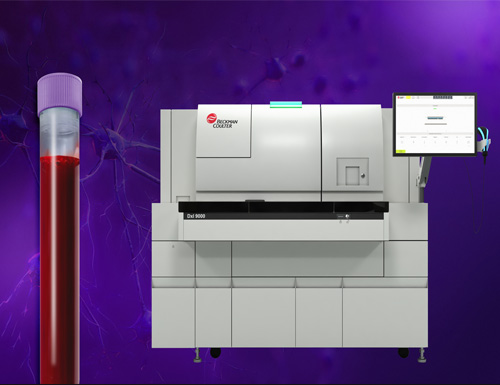
Beckman Coulter Diagnostics is advancing its Alzheimer's disease portfolio on the DxI 9000 Analyzer, a highly sensitive, scalable platform designed to detect low-abundance biomarkers with consistency. By enabling both the CE-marked Access p-Tau217 assay and the Access BD-pTau217 (RUO), as well as existing Access GFAP (RUO), Access BD-Tau (RUO), Access NfL (RUO), Access Beta-Amyloid 1-42 (RUO) and Access apoE ε4 (RUO) assays to run on a common platform, laboratories can integrate diverse testing capabilities within a consistent, high-throughput workflow.
"High-sensitivity detection, robust assays, and operational scalability are critical as blood-based biomarkers become more widely adopted," said Dr. Nick Culshaw, Vice President and Managing Director, Clinical Chemistry and Immunoassay Business at Beckman Coulter Diagnostics. "By anchoring our Alzheimer's disease portfolio on the DxI 9000 Analyzer, we are enabling laboratories to access an expanding set of biomarker insights, from clinical assessment to research applications, within a single system."
The DxI 9000 Analyzer combines analytical sensitivity with operational flexibility, allowing laboratories to support a growing range of biomarker applications, from routine clinical evaluation to advanced research into disease biology, without compromising performance or efficiency. This unified platform approach helps ensure consistency in assay execution while enabling expansion into emerging markers across neurodegenerative diseases as scientific understanding evolves.
At AAIC 2026 in London, Beckman Coulter Diagnostics will highlight new data advancing blood-based testing for Alzheimer's disease through a focused program of scientific presentations and expert engagement.
The company will present five posters on pTau217 and novel biomarker approaches, including data demonstrating improved detection of Alzheimer's pathology and enhanced performance using biomarker ratios and next-generation assays. Featured research spans clinical utility, disease staging and assay innovation, as well as late-breaker findings on pTau217/Aβ42 and BD‑Tau ratio approaches.
Key on-site engagements include:
- Enabling Alzheimer's Biological Staging with Blood Based Biomarkers, featuring James Doecke, PhD, and Charbel Abou-Diwan, PhD, Senior Director, Medical & Scientific Affairs, Beckman Coulter Diagnostics, July 13, 10:30–11:00 AM
- Improving real-world representation in Alzheimer's disease research and treatment, Opening remarks by Jeremiah Hinson, M.D., Ph.D., followed by Sid E. O'Bryant, Ph.D.; Suzanne Craft, Ph.D.; Carlos Cruchaga, Ph.D.; Michelle Mielke, Ph.D.; Charlotte Teunissen, Ph.D.; and Michael Weiner, M.D. July 13, 12:30–1:45 PM
Attendees can also visit the Beckman Coulter Diagnostics booth #921 to connect with experts and explore how high-throughput immunoassay platforms are supporting scalable adoption of blood-based biomarker testing.
About Beckman Coulter. Inc.
Beckman Coulter Diagnostics is a global leader in advanced diagnostics, helping laboratories transform insight into impact through science, technology, and collaboration. For more than 90 years, the company has challenged convention to elevate the role of the diagnostic laboratory, accelerating ideas from discovery to real world clinical outcomes. Guided by its mission to Relentlessly Reimagine Healthcare, One Diagnosis at a Time, Beckman Coulter Diagnostics delivers trusted solutions for complex clinical testing across hospitals, reference laboratories, and physician office settings worldwide, supported by an extensive clinical menu, scalable automation, actionable informatics, and lab performance optimization services. Part of Danaher, a global science and technology innovator, Beckman Coulter Diagnostics draws on a connected network of specialized companies—combining shared capabilities, scale, and expertise to help solve some of healthcare's most complex challenges, together. Headquartered in Brea, California, the company employs more than 11,000 associates globally.
About Danaher
Danaher is a leading global life sciences and diagnostics innovator, committed to accelerating the power of science and technology to improve human health. Through our connected ecosystem of industry-leading businesses, we work side by side with customers to solve their most complex scientific and clinical challenges—helping move innovations from discovery to delivery faster for patients who depend on them.
Powered by the Danaher Business System, our advanced science and technology and proven ability to innovate help enable faster, more accurate diagnoses and reduce the time, cost, and risk required to discover, develop, and deliver life-changing therapies. Through continuous improvement and operational excellence, our approximately 60,000 associates worldwide are focused on delivering lasting impact and improving quality of life around the world, while building a healthier, more sustainable tomorrow.