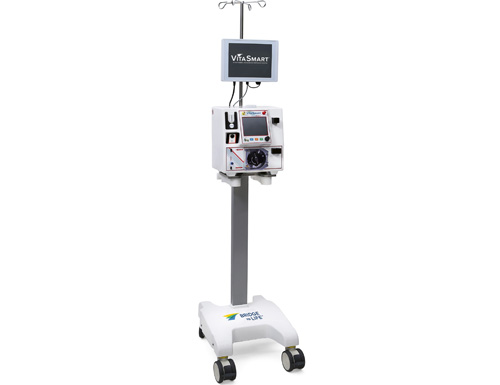
Bridge to Life also announced today that Duke University Hospital has successfully preserved their first donor liver prior to transplantation with the VitaSmart™ HOPE System. The donor liver was from a Donation after Circulatory Death (DCD) donor.
"The ultimate goal is to provide the greatest access possible to all our patients on the waitlist," said Dr. Andrew Barbas, Associate Professor of Surgery and surgical director of the liver transplant program at Duke University Hospital. "Hypothermic liver perfusion provides our team with yet another approach to expand the donor pool in liver transplantation."
"We are thrilled that our new VitaSmart™ System has been implemented to successfully preserve donor livers prior to transplantation," said Don Webber, CEO and President of Bridge to Life™ Ltd. "After years of use and thousands of liver transplants utilizing our VitaSmart™ System in the European Union (EU), we now mark another major company milestone with VitaSmart™ availability to the U.S. transplant community.
The FDA-cleared labeling supports broad clinical applicability, including Donation after Circulatory Death (DCD) donors, and positions VitaSmart™ as a scalable and economically compelling platform for U.S. transplant centers."
Labeling Designed to Support Real-World Clinical Practice
The FDA-cleared labeling for VitaSmart™ supports hypothermic oxygenated perfusion of donor livers prior to transplantation in both Donation after Brain Death (DBD) and Donation after Circulatory Death (DCD) donors, within defined donor criteria.
Importantly, the cleared indication does not specify a maximum machine perfusion duration, allowing clinicians to apply hypothermic oxygenated perfusion using clinical judgment and established protocols within the scope of the indication. Extended HOPE duration provides operational and patient safety advantages, including improved coordination of transplantation logistics, avoidance of rushed implantation, and reduced risk of re-exposure to static cold ischemia. These factors directly impact intraoperative stability and post-transplant outcomes.
Purpose-Built HOPE Technology for U.S. Adoption
VitaSmart™ delivers hypothermic oxygenated perfusion by cooling donor livers to controlled hypothermic temperatures while providing oxygenated perfusate prior to transplantation. The system is engineered for reliability, simplicity, and ease of use, supporting adoption across a wide range of transplant center environments under its FDA-cleared indication.
Bridge to HOPE Pivotal Clinical Trial
FDA clearance was based on data from the first multicenter, randomized trial conducted in the United States to evaluate the clinical impact of end-ischemic Hypothermic Oxygenated Perfusion (HOPE) after static cold storage (SCS) compared to SCS only.
Highlights of the Bridge to HOPE Pivotal Clinical Trial include:
- Early Trial Closure: The trial was closed early after the primary efficacy endpoint demonstrated statistical superiority at a pre-defined interim analysis.
- Reduced Hospital Stay: Hospital length of stay was statistically significantly shorter with HOPE compared to SCS alone, which may have implications for healthcare resource utilization and costs.
- Significantly Lower Incidence of Early Allograft Dysfunction (EAD): Portal venous HOPE was associated with less EAD compared to SCS, representing improvement in early liver graft function.
- End-ischemic portal venous HOPE demonstrated trends toward less DCD graft failure requiring re-transplantation, less steroid-resistant liver rejection and a lower incidence of biliary complications with an excellent safety profile. HOPE offers a safe, simple and effective approach to organ preservation and provides a valuable option for dynamic preservation of liver allografts.
Designed to Complement Bridge to Life's Gold-Standard Preservation Solutions
Bridge to Life is also proud to provide recently FDA-cleared multi-sourced Belzer UW® and MPS® organ preservation solutions. Notably, this clearance includes expanded labeling for Belzer MPS® UW Machine Perfusion Solution to cover all abdominal organs — a first-of-its-kind milestone in the field of transplantation. To ensure uninterrupted access, the company maintains a minimum 60-day global inventory buffer and has established multiple exclusive supplier agreements across key regions. This approach enhances operational resilience and mitigates supply chain risks, while also enabling the delivery of highly customizable solutions to meet the evolving needs of our customers. With longstanding exclusive rights to Belzer UW® and MPS® from the University of Wisconsin and the addition of BTL-owned EasiSlush®, the company has built a portfolio of trusted brands that have supported transplants for more than a decade.
About Bridge to Life™ Ltd.
Bridge to Life™ Ltd. is a global leader in organ preservation solutions, offering a comprehensive portfolio that includes Belzer UW®, EasiSlush®, and the VitaSmart™ Hypothermic Oxygenated Perfusion System. Bridge to Life partners with transplant centers and organ procurement organizations worldwide to advance preservation science and support life-saving transplantation.
For more information, please visit www.bridgetolife.com.