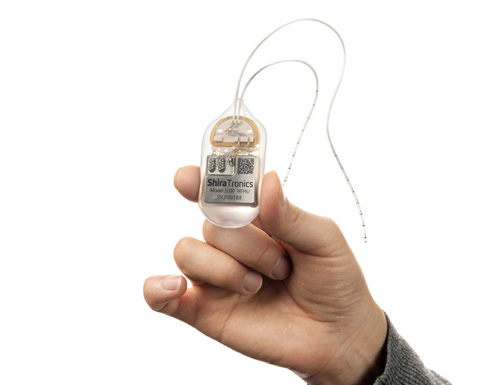
Arriving within the same window, the two developments point in the same direction. Patients and physicians completed pivotal enrollment at pace, signaling real demand for a new approach; the AMA, working independently, codified the procedure as distinct clinical work. Together they mark growing recognition of an emerging category, Implantable Extracranial Neuromodulation Systems (IENs) — of which the investigational ShiraTronics system is the first device purpose-built for chronic migraine.
RELIEV-CM2 is a prospective, multicenter, double-blind, randomized pivotal IDE study evaluating the safety and efficacy of the ShiraTronics system in adults with chronic migraine. Across 28 U.S. and Australian clinical sites, the study enrolled 300 participants in just over 18 months – with every site both enrolling and implanting participants – reflecting rapid, broadly distributed execution in a chronic migraine population for which clinical-trial enrollment has historically proven difficult. As of trial completion, 146 participants have received an implant of the investigational device. The company acknowledged the contributions of investigators, study coordinators, and patients across all participating sites; enrollment closure positions the program to advance toward its planned readout sequence and future regulatory submission.
These milestones build on the positive results of the earlier RELIEV-CM Pilot Study, which demonstrated clinically meaningful and durable reductions in monthly headache days through 12 months, alongside improvements in migraine-specific quality of life and a consistently favorable safety profile with no unanticipated adverse events.
"Two things happened in close succession that, together, mean more than either does alone," said Rob Binney, Chief Executive Officer of ShiraTronics. "Special recognition and gratitude to the patients, investigators, and study teams who entrusted us with this work, without whom none of this happens. The pace of pivotal enrollment told us, directly, that the unmet need is real. The AMA CPT Editorial Panel, working from a very different vantage point, reached a parallel conclusion when they accepted a dedicated five-code set for this procedure. One vote from the people living with this disease and the clinicians who care for them. One vote from the institutional infrastructure that defines how medicine recognizes new procedural categories. Our job now is to keep earning the trust both groups have already extended."
In February 2026, the AMA CPT Editorial Panel accepted five Category III CPT codes for bilateral supraorbital-occipital neurostimulator services, effective January 1, 2027. The significance is more than administrative. For a patient population long served only by medications and externally worn devices, a dedicated set of CPT codes marks the recognition of a genuinely new procedural category – one distinct enough to warrant its own place in the clinical taxonomy rather than a variation on something that came before. Category III codes are tracking codes for emerging services; on their own, they do not establish coverage or payment, which remain payer-determined, and they do not constitute a clinical endorsement. But their acceptance ahead of approval is a meaningful early signal that this approach is being recognized on its own terms.
"When a procedure earns its own dedicated codes, it means the people who define how medicine is described have looked at it and concluded it is differentiated from prior procedures," said Joshua Rosenow, MD, neurosurgeon and a RELIEV-CM2 investigator. "For those of us who implant these systems, that recognition carries real weight. It says the procedure we are evaluating in RELIEV-CM2 is a novel advance, and that the framework to describe it accurately is already taking shape. That is an important step for the field, and for the patients who have been waiting for something genuinely new."
The investigational ShiraTronics system is a fully implantable neurostimulator designed specifically for chronic migraine, delivering targeted neurostimulation to the trigeminal nerve complex, which is highly implicated in migraine. Because it is designed to deliver therapy continuously, the system is intended to work to prevent migraine around the clock rather than responding only once an attack has begun. It is a purpose-built therapy that requires no external hardware or wearables to deliver treatment: once implanted, it delivers ongoing therapy discreetly in the background of a patient's life, without the routines or daily effort that many existing options require. The design intent is straightforward – a therapy that works for the patient rather than asking the patient to work for it.
"As the national co-principal investigators for RELIEV-CM2, we have seen firsthand how many people with chronic migraine remain inadequately served despite the real advances of recent years," said Samer Narouze, MD, PhD, and Brian Grosberg, MD, national co-principal investigators of the RELIEV-CM2 study. "Completing pivotal enrollment in a rigorous, randomized study of this design is a significant step, and the engagement we saw across sites reflects how much need remains for new, evidence-based options. We look forward to the data, and to what a purpose-built approach could add to the care of patients who have exhausted much of what is currently available."
Both milestones reflect the company's thesis that patients living with chronic migraine have been waiting for a purpose-built implantable option, and that the surrounding clinical, regulatory, and reimbursement infrastructure can be built in parallel rather than one step at a time. ShiraTronics received FDA Breakthrough Device Designation in 2021 and has raised $108M to date. With pivotal enrollment now complete, the company is preparing for its planned readout sequence and intends to pursue Premarket Approval (PMA) from the FDA, with an anticipated limited commercial launch following clinical results and regulatory review.
About ShiraTronics
ShiraTronics, Inc. is a clinical-stage medical device company dedicated to advancing neurostimulation therapies for people living with chronic migraine. The company is developing the first purpose-built device in the emerging category of Implantable Extracranial Neuromodulation Systems (IENs), designed specifically for chronic migraine. ShiraTronics is headquartered in Minneapolis, Minnesota.
For more information, please visit www.shiratronics.com.